> ## Documentation Index
> Fetch the complete documentation index at: https://lightdash-mintlify-cccf65ca.mintlify.site/llms.txt
> Use this file to discover all available pages before exploring further.
# Sankey chart
> Use Sankey charts to visualize flows between categories, showing how values move from sources to targets.
This feature is in [Beta](/references/workspace/feature-maturity-levels). We'd love your feedback as we continue to improve it.
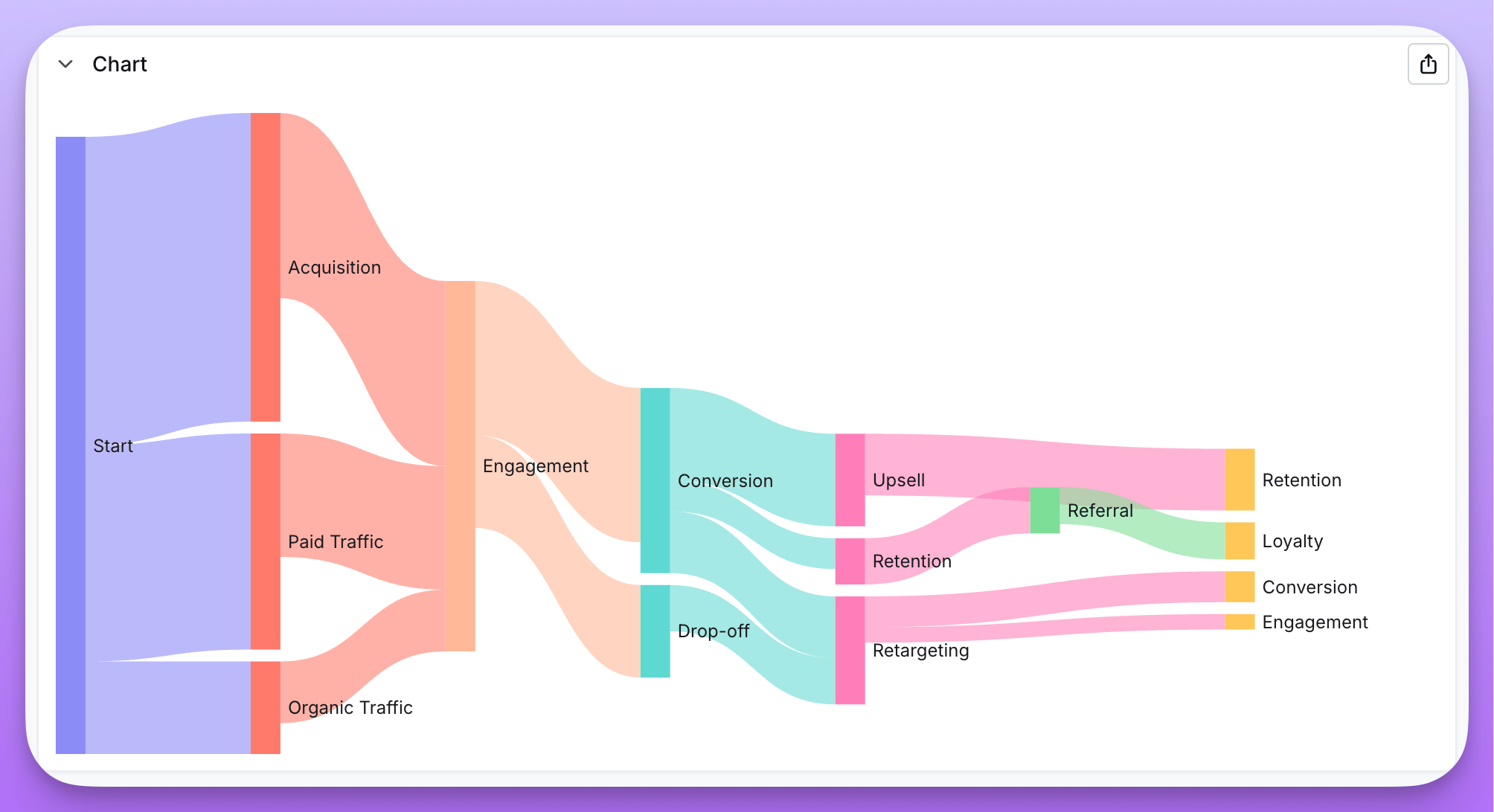 Sankey diagrams visualize flows between categories — how values move from a source to a target, weighted by a metric. They're ideal for understanding movement, distribution, or conversion across stages.
Sankey charts are useful when:
* You want to show how values flow between categories (e.g., marketing channels → conversions)
* You're visualizing multi-step processes or funnels
* You need to understand distribution across interconnected stages
* You have cyclical flows that loop back (e.g., retargeting → conversion → retargeting)
## Data requirements
Sankey charts require **three columns** in your data:
| Column type | Description | Example |
| -------------------- | ------------------------- | -------------------------------------------- |
| **Source dimension** | Where the flow originates | `channel`, `referrer`, `stage_from` |
| **Target dimension** | Where the flow goes | `conversion_type`, `destination`, `stage_to` |
| **Weight metric** | The size of the flow | `count`, `revenue`, `users` |
Each row in your data represents a flow from one node to another, with the weight determining the thickness of the connection.
## Creating a Sankey chart
1. Run a query with your source dimension, target dimension, and weight metric
2. Select **Sankey** from the chart type picker
3. In the configuration panel, assign:
* **Source** — the dimension representing flow origins
* **Target** — the dimension representing flow destinations
* **Value** — the metric determining flow size
## Features
### Multi-step flows
Sankey charts automatically handle nodes that appear as both sources and targets, creating multi-level visualizations. For example, if "Email" appears as a target from "Ad Click" and as a source to "Purchase", the chart will show the full flow path.
### Cyclical flows
Unlike traditional Sankey implementations, Lightdash supports cyclical data where flows can loop back. For example, in a retargeting funnel:
* Awareness → Consideration
* Consideration → Conversion
* Conversion → Retargeting
* Retargeting → Conversion (loop)
The chart handles these cycles by creating step-suffixed node instances (e.g., "Conversion - Step 2").
### Node layout
The **Node layout** option controls how a label that appears at more than one depth is rendered. For funnels where a single stage is reached from several preceding steps, the default can make one real stage look like several different nodes, so you can choose between three layouts:
* **Multi-step** (default) — Each occurrence of a label at a different depth is rendered as a separate node, including cycles, which become "Step N" instances as described above. This preserves the full journey.
* **Merged** — Collapses nodes that share a label into a single node, so all flows in and out of that label converge on one node while the multi-step journey is preserved. Available for acyclic flows only; when your data contains a loop the option is disabled and the chart falls back to multi-step.
* **Direct** — Shows only direct source → target flows in two columns, with no multi-step chaining. A label that is both a source and a target appears once on each side. This works for any data, including cyclical flows.
## Display options
* **Orientation** — Display flows horizontally (left to right) or vertically (top to bottom)
* **Node alignment** — Align nodes to the left, right, or justify across the chart
* **Node layout** — Choose how nodes are arranged: **Multi-step** (depth-based journeys, the default), **Merged** (one node per label, acyclic flows only), or **Direct** (two-column source → target only)
Sankey diagrams visualize flows between categories — how values move from a source to a target, weighted by a metric. They're ideal for understanding movement, distribution, or conversion across stages.
Sankey charts are useful when:
* You want to show how values flow between categories (e.g., marketing channels → conversions)
* You're visualizing multi-step processes or funnels
* You need to understand distribution across interconnected stages
* You have cyclical flows that loop back (e.g., retargeting → conversion → retargeting)
## Data requirements
Sankey charts require **three columns** in your data:
| Column type | Description | Example |
| -------------------- | ------------------------- | -------------------------------------------- |
| **Source dimension** | Where the flow originates | `channel`, `referrer`, `stage_from` |
| **Target dimension** | Where the flow goes | `conversion_type`, `destination`, `stage_to` |
| **Weight metric** | The size of the flow | `count`, `revenue`, `users` |
Each row in your data represents a flow from one node to another, with the weight determining the thickness of the connection.
## Creating a Sankey chart
1. Run a query with your source dimension, target dimension, and weight metric
2. Select **Sankey** from the chart type picker
3. In the configuration panel, assign:
* **Source** — the dimension representing flow origins
* **Target** — the dimension representing flow destinations
* **Value** — the metric determining flow size
## Features
### Multi-step flows
Sankey charts automatically handle nodes that appear as both sources and targets, creating multi-level visualizations. For example, if "Email" appears as a target from "Ad Click" and as a source to "Purchase", the chart will show the full flow path.
### Cyclical flows
Unlike traditional Sankey implementations, Lightdash supports cyclical data where flows can loop back. For example, in a retargeting funnel:
* Awareness → Consideration
* Consideration → Conversion
* Conversion → Retargeting
* Retargeting → Conversion (loop)
The chart handles these cycles by creating step-suffixed node instances (e.g., "Conversion - Step 2").
### Node layout
The **Node layout** option controls how a label that appears at more than one depth is rendered. For funnels where a single stage is reached from several preceding steps, the default can make one real stage look like several different nodes, so you can choose between three layouts:
* **Multi-step** (default) — Each occurrence of a label at a different depth is rendered as a separate node, including cycles, which become "Step N" instances as described above. This preserves the full journey.
* **Merged** — Collapses nodes that share a label into a single node, so all flows in and out of that label converge on one node while the multi-step journey is preserved. Available for acyclic flows only; when your data contains a loop the option is disabled and the chart falls back to multi-step.
* **Direct** — Shows only direct source → target flows in two columns, with no multi-step chaining. A label that is both a source and a target appears once on each side. This works for any data, including cyclical flows.
## Display options
* **Orientation** — Display flows horizontally (left to right) or vertically (top to bottom)
* **Node alignment** — Align nodes to the left, right, or justify across the chart
* **Node layout** — Choose how nodes are arranged: **Multi-step** (depth-based journeys, the default), **Merged** (one node per label, acyclic flows only), or **Direct** (two-column source → target only)